
How to Manage Projects (for Chaotic Minds)
Methods for freeing our creativity from executive dysfunction

What is a writer who doesn’t write? A fraud, a liar, a poser – these are all things I labeled myself as for the better part of two years. I fell in love with the practice, started a Substack publication, and then… nothing. There was an initial surge of content for a few months – the feverish drive of an ADHD brain – that saw me churning out a few articles, but it didn’t last. At first, I settled on the cruel labels I just mentioned, but it turns out they were A) not true, and B) not useful. I emptied countless ink cartridges into over six full notebooks, four of which were solely for school notes. I wrote plenty of essays during my time at Forsyth Tech, many of which I felt some warm pride for. I.e. I was writing; I was a writer. I thought: “If that’s the case, then why can’t I finish or even dedicate consistent time to my personal projects?” I needed something more sustainable.
My answer was in the question: projects. I realized that most of my efforts outside of school weren’t organized; I was winging it, nothing but myself, my notes, and the yawning void of the blank page. My process was monolithic and thus imposing, yet also helplessly contingent upon my whimsy. Furthermore, I learned that most of these surface level issues I was encountering had roots that ran deep into my executive dysfunctions – problems with higher-level cognitive processes, such as prioritization, organization, and self-regulation. So, I endeavored the same way I endeavored for school – I got organized. Voila! My Frankenstein was born: a three-tiered project management framework designed for my attention disorder. If you have ADHD and/or struggle with all-or-nothing thinking, a cruel inner critic, and long-term organization, these methods could shift your perspective on what projects are and how they can help you.
Pause! Time for a preface in two parts. First, the foundation of these ideas lies in the Bullet Journal method, developed by Ryder Carroll (Bullet Journal). If you’ve binged the productivity side of YouTube or scrolled through the mindfulness sphere of Instagram in the last five years, there’s a solid chance that you’ve come across the trendy notebook spreads – stark in their aesthetics, clean lines demarcating a crisp white page with habit trackers regimented and bullet points sprinkled in neat rows. It’s honestly a vibe, and that’s what drew a lot of people in, including myself. My thoughts on projects and how to organize them aren’t exclusive to bullet journaling, though; the concepts are system-agnostic. However, the images and tools I will be providing are submerged within the context of that system, so feel free to adapt the core ideas to work in your setup. It only matters if it works for you.
Second, to piggy-back off of the last point, this approach is not one-size-fits-all. There’s a massive margin of error between different systems – especially between analog and digital – where our methods can tumble into the dark gaps. My heuristic? Adapt, adapt, adapt. Always configure your approach for you; don’t install tools that don’t fit.
The Why
Now, before I get into the nuts and bolts of my framework, I can hear you shouting: “Have you forgotten? You have to actually offer something to interest your audience, Ray!” Of course, you’re right, rhetorical audience, but you didn’t have to be so abrasive. So, alright, why should chaotic minds consider organizing more of their lives through the lens of projects?
Imagine: an obsidian wall scraping the sky, strings of binary code flickering in long ribbons from within, grim and impassable. As someone with an attention disorder, the trap of all-or-nothing thinking can make certain endeavors (even simple ones) an insurmountable monolith. It may seem silly for someone with a neurotypical brain, but I routinely struggle with laundry, cleaning, and other multi-step chores. Executive dysfunction can make the act of initiation a gauntlet of false starts, which in turn often leaves me with an ADHD-er’s worst nightmare – an open task.
Thinking strictly in terms of tasks is appealing to the rote binary of all-or-nothing thought, but ultimately lets precious small victories slip between the margins. In my experience, an effective remedy for a brain bent on ones or zeroes is to acknowledge the small wins, no matter how puny. Take laundry: if you think about it, that chore can be considered a simple project. There’s several, but undeniably distinct steps to the process. If starting the entire process is such an issue, then why not just start part of it? Incremental progress. I didn’t have to hide from the binary monolith; I could slip through the nuanced space between the numbers. This is a common tip from ADHD coaches for a reason: If completion is too much, scale down what completion means.
A neat little side effect of incremental progress is how it can disarm a cruel inner critic. You see, we all have this little guy in our heads whose entire job is to hold us accountable. He paces through the streets and alleys of our minds, cigarette burning and trench coat billowing, eyes narrowed on our transgressions. Accountability is good, but it can get out of hand. Mine takes his job too seriously: he arrests on the spot, skips due process, and spins conspiracy theories – red-stringed corkboard and all. In other words, I self-flagellate over the smallest failures, even fictional ones.
If you have a similar problem, think about this: Using projects to curb your all-or-nothing thinking consequently deprives such an overactive critic of ammunition. Giving yourself some grace means he won’t be able to exaggerate your mishaps or even worse, entirely fabricate misdeeds and failures. Don’t strip him of his rank but maybe trade his pistol for a baton.
Of course, beyond all of this, thinking in projects makes long-term plans actually approachable. If there’s any experience that ADHD-er’s will understand, it’s the endless wasteland of broken ideas and half-finished projects. How bleak and miserable. A little story: There was a time a year or so ago when I felt so bitterly towards my inability to finish projects that I believed starting anything new to be futile. I didn’t trust myself to see a new project through; I expected disappointment from the desert. So, I stopped trying. I gave up. Then, a light broke through the clouds – project management, the shining knight in spreadsheets.
Turns out, it’s easy to lose sight of the vision when said vision is comprised entirely of bleary, scattered aspirations – no more than hazy mirages. My goals were abstract and removed from immediacy; of course I fell off the saddle. My time blindness and my working memory issues made it difficult to maintain momentum with my creative projects. So, what’s the opposite of bleary and scattered? Clear and concentrated. This means organizing my efforts in a visual, centralized way, giving the project a place to live and grow (for me, that place is my notebook; the growth metaphor feels appropriate when burying ink into pulp). Thinking in projects made all the difference for my long-term endeavors.
The What
Now that the why of my framework is out of the way, I can get into the what. The reasons for a system are important and dignified, but let’s not kid ourselves: we’re here for the good stuff, right? Now, don’t play coy; I know that you guys are itching for new tools like I am, no better than crows with their shiny hoards. Let’s not keep you guys waiting. The little system I’ve cobbled together for myself works on three levels in ascending importance and temporal scope.
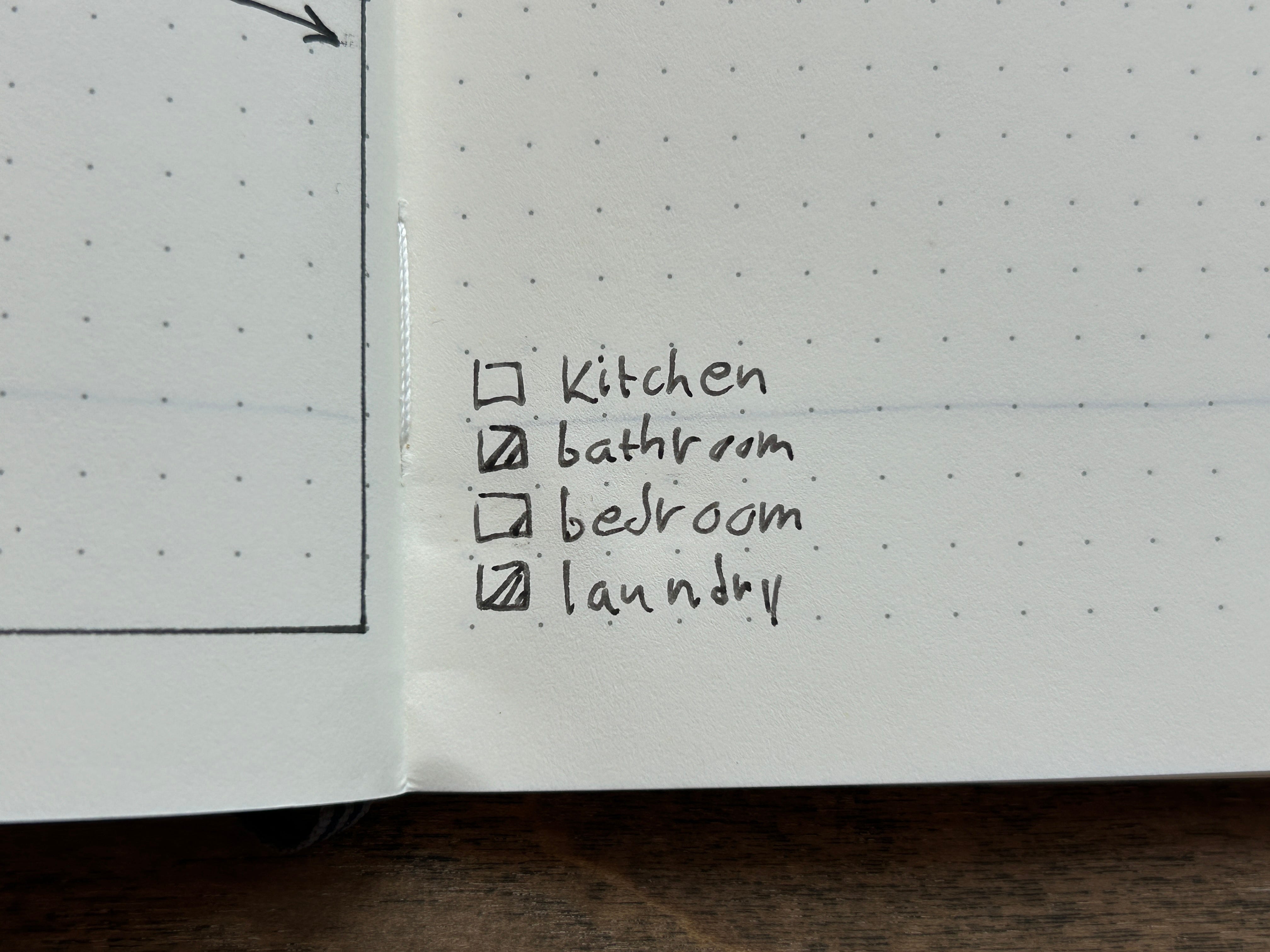
The first level I call simple projects. This level has been the most helpful for my domestic struggles because it reframes my relationship with chores – from all-or-nothing to incremental progress, as discussed earlier. The way I represent these projects is with what I call a project bullet: a little square that I fill in based on the rough percentage of the project completed. If you’re familiar with the traditional use of status bullets in the Bujo practice, then this might jive with you. In particular, this kind of bullet usually fits into my daily and weekly logs, given this level’s ephemerality and reduced importance, making it perfect for chores, hobbies, paperwork etc. Many people would consider these categories to be no more than tasks, but others (including myself) find them floating on the periphery of that classification, just out of reach. Again: scale down what completion means.
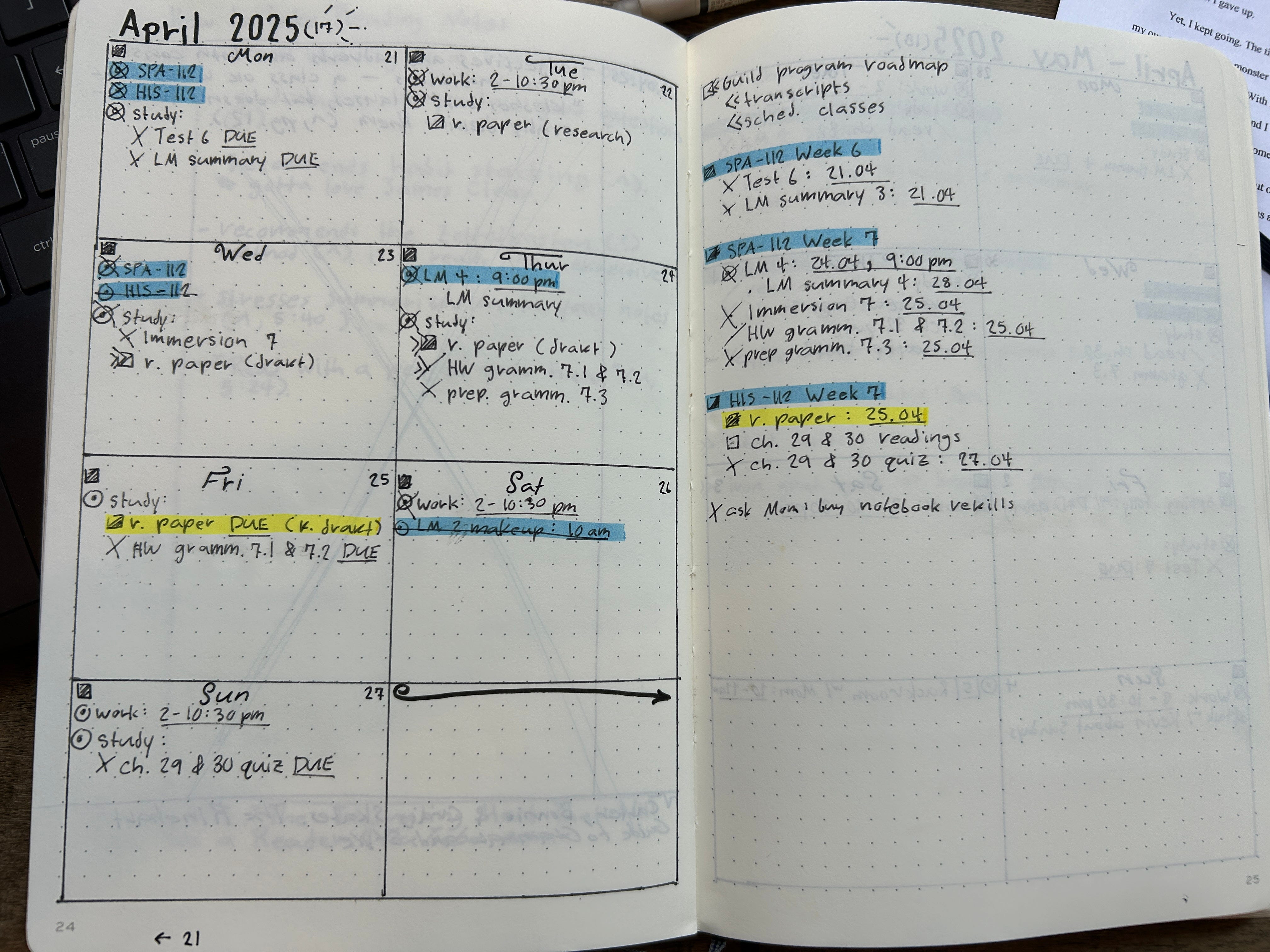
The second level is a personal favorite in my toolbelt – road mapping. It’s an adventurous little name, but roadmaps are essentially glorified checklists with a timely element. Basically, these are more bona fide projects as most would consider them: creative endeavors, business enterprises, administration processes, etc. They typically exist on a larger time scale than tasks and simple projects, accompanied by a moderate level of importance, making them right at home in my weekly and monthly logs. That timely characteristic I mentioned earlier is this strategy’s namesake: I create a new item with the project bullet, as I would with a simple project, but this time I nest the appropriate tasks underneath it (again, like standard Bujo practice). Then, I take those tasks and sprinkle them throughout my week or month. This allows me to space out my workload to avoid burnout. Any students here, listen: give something like this a go, please. This planning method was instrumental in my Associate’s degree program. Having a centralized plan and an evenly spread workload was like finding a shelter and radio amongst the desert ruins.
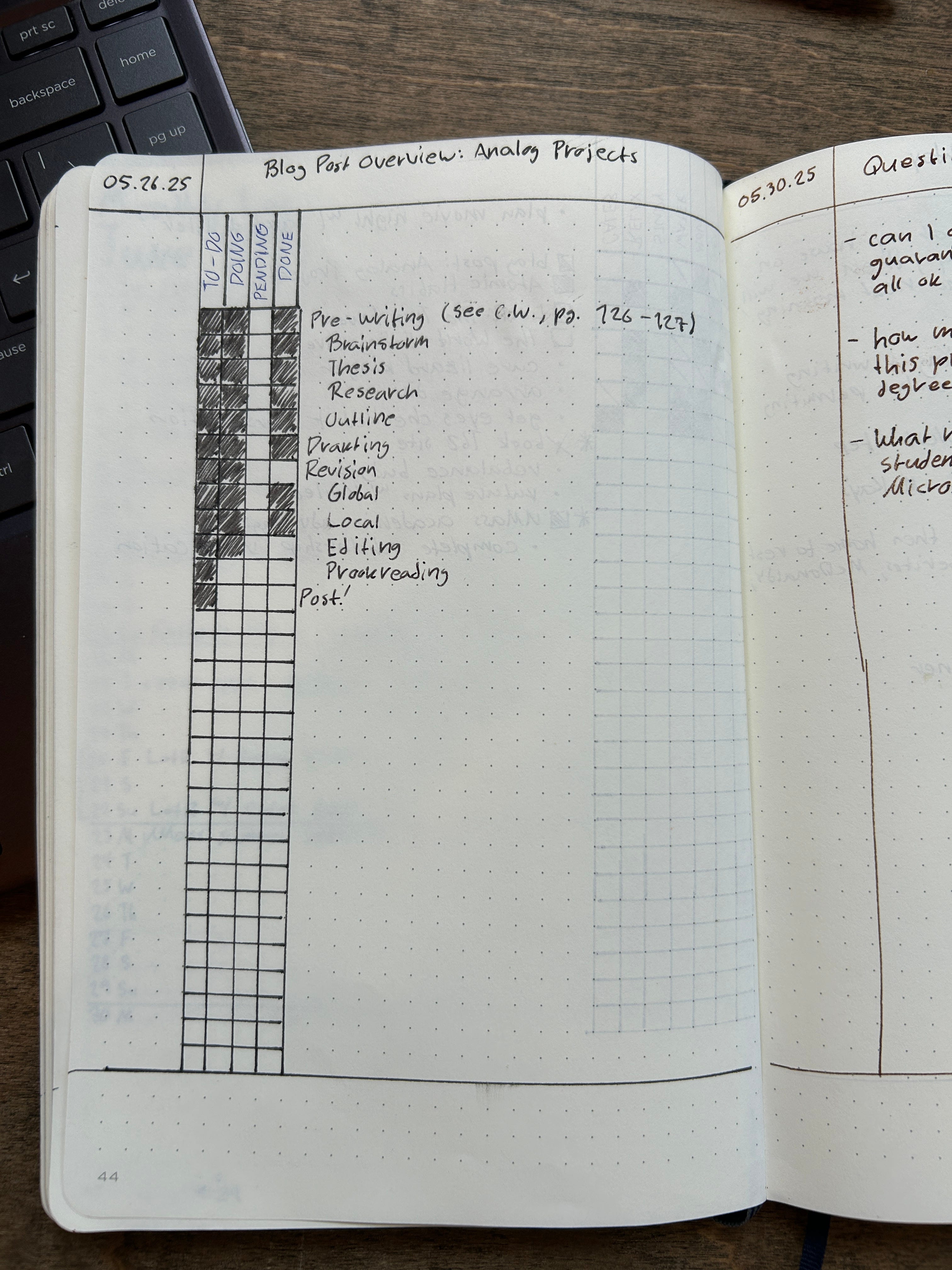
The third level, largest in temporal scope and highest in importance, is the project overview. To preface: I wouldn’t recommend this strategy to everyone. It’s a little more involved and technical, probably more so than is necessary for most people. However, if you have creative projects that always end up on the back burner and you want to give them some time to cook for once, I would try something like this. Essentially, this method takes your project and dedicates a proper page to it, where you can fine-tune your tracking of tasks with the Kanban method. As you can see, I’m tracking the individual action items for this very post with a Kanban-esque grid – a manifestation of the technique known as the Alastair method (Johnston). The “PENDING” column is my own addition: it’s nice to track when a particular task is out of my hands, usually when I’m waiting on an academic coach to respond to an email or a friend to finish proofreading (ahem, Kaylee). Sometimes I forget.
Ticking the Last Box
Before I decided to get organized, I was mired by my brain’s bad actors: I couldn’t penetrate the stubborn monolith of all-or-nothing thought; I couldn’t pacify the deranged private eye that was my inner critic; I couldn’t find any hope in the bleak wasteland of my failed projects. Again: I gave up.
Yet, I kept going. The tinkering commenced. Slowly and deliberately, I pieced together my own Frankenstein’s monster from YouTube videos and blog posts. Eventually, I settled on my design and got to work. With my flawed creation, I found the gaps in my monolith, I reformed my little detective, and I finally built something out of my scrapyard. I didn’t just find something sustainable; I made something sustainable.
Of course, I say “made,” but only in the sense of a remix. This little system is the product of inspiration – as nearly all creations are – from various ideas and tips from creators on the internet, most notably Ryder Carroll and Alastair Johnston respectively. This is to say that experimentation is vital: We shouldn’t simply copy the methods of others wholesale; we should adapt, adapt, adapt. Funnily enough, it was this adaptation principle that was my core discovery in this journey. Beyond the why and the what, I found the practice – evolution. This is why we share our systems and binge each other’s content. As a species that loves solving puzzles, the most rewarding puzzle to solve is ourselves.
I never thought I would find the missing pieces to my own puzzle. Too much was absent; how could I possibly progress if I couldn’t find a place to start? Turns out, I only needed to figure out three things – all-or-nothing thinking, a cruel inner critic, and long-term organization – before the other pieces fell into place. If you have similar struggles, ADHD or not, I hope you find something worthwhile in my design. Keep evolving.
Works Cited
Bullet Journal. “The Bujo Backstory.” Bullet Journal, https://bulletjournal.com/pages/story.
Johnston, Alastair. “Projects: The Alastair Method.” Bullet Journal, 26 June 2025, https://bulletjournal.com/blogs/bulletjournalist/projects-the-alastair-method?srsltid=AfmBOorhkgtWn7PxGre6j_A2AqBcGBoghfPlDGwURGYr3zMdgCWc_IEO.